

UN Global Compact Network Nigeria hosts Private Sector Dialogue on Business and Human Rights
On 19 June 2026, the UN Global Compact Network Nigeria (UNGCNN) convened its Private Sector Dialogue on Business and Human Rights at Lagos, bringing together business leaders, government representatives, human rights experts, development partners, and sustainability practitioners for a full day of honest, practical conversation.
The theme — Business and Human Rights as a Business Advantage: Building the Accountability Practices That Earn Lasting Trust — set the tone for a dialogue that refused to treat human rights as a compliance box to tick. From the opening address through to the closing panel, one message came through clearly: trust is not built through policy documents. It is earned through systems, consistency, and action.
The event also marked the graduation of the 2026 Business and Human Rights (BHR) Accelerator Programme in Nigeria, recognising companies that had committed since January to developing robust human rights due diligence (HRDD) plans for their operations.
Setting the Stage
Welcoming delegates, Naomi Nwokolo, CEO and Executive Director of UNGCNN, noted that across global markets, investors, regulators, consumers, and business partners increasingly expect companies to demonstrate accountability, transparency, and respect for human rights throughout their operations and value chains.
“Respect for human rights is no longer separate from business success. Increasingly, it is one of its very strong foundations,” she said, underscoring the Network’s commitment to facilitating both learning and action on the business and human rights agenda.
Uto Ukpanah, Board Chair of UNGCNN, reinforced that the conversation around responsible business conduct has moved well beyond declarations — investors now go directly to supply chains. Danish partners and their representatives received a special acknowledgement for their continued support in strengthening this work.
The Government Voice: NHRC Calls for Partnership, Not Paper
The keynote address — delivered by Pwadumdi Okoh Esq., Director Legal and Business and Human Rights Focal Point Lead at the National Human Rights Commission (NHRC) on behalf of the Executive Secretary — was perhaps the most direct intervention of the morning.
Speaking frankly, she outlined the three-pillar framework of business and human rights: government’s duty to protect, business’s responsibility to respect, and the obligation to ensure access to remedy when violations occur. She made clear that Nigeria, as the third country to adopt a National Action Plan (NAP) on Business and Human Rights, now needs implementation — not just recognition.
Her call to action for companies was concrete:
- Commission a focused human rights due diligence on your most salient operations or suppliers and publish a remediation roadmap within six months.
- Adopt a supplier human rights clause and pilot it with five to ten strategic suppliers.
- Sign a memorandum of understanding with the NHRC to design or endorse a grievance mechanism tailored to your sector.
She was candid about the realities Nigerian companies face — from complex supply chains to jurisdictional battles the Commission is fighting all the way to the Supreme Court over environmental rights — and equally candid that no institution can do this alone. “When the government, the commission, and businesses come together, there is progress.”
Lagos State Ministry: Accountability as Economic Strategy
A representative of the Lagos State Ministry of Wealth Creation and Employment, delivering remarks on behalf of the Honourable Commissioner, framed human rights accountability as an economic strategy, not a burden.
“Trust has become one of the most valuable currencies in business, and accountability is the foundation upon which that trust is built,” the address noted, calling on private sector leaders to view human rights not as a compliance obligation but as an opportunity to create value and earn lasting trust.
Lagos State’s alignment with the Sustainable Development Goals and international responsible business frameworks was highlighted, with emphasis on the administration’s commitment to building a 21st-century economy that leaves no one behind.
Accelerator Spotlight: Companies Putting in the Work
Three companies in the 2026 BHR Accelerator Programme shared their journeys — an honest account of what it actually takes to move from policy to practice.
Sahara Group
Representing Sahara Group — a fully integrated energy company operating across 42 countries in oil and gas, power, infrastructure, and data and technology — Lauretta Eguabor (Governance and Sustainability Executive) and Ebelechukwu Ifeka (Employee Relations Specialist) walked the room through their human rights commitments and what the accelerator made real.
Sahara’s approach rests on a formal Human Rights Policy aligned to the UN Guiding Principles, clear accountability structures, and active awareness programmes that extend to all staff including casual workers and drivers. Their key learnings from the programme were instructive for companies of any size:
- Linkage creates responsibility — being linked to harm is sufficient to require action. Sahara does not need to have caused harm directly; this shifted how they think about supply chain and security partner liability.
- Trust is the mechanism — a grievance mechanism is only as good as the trust people have in it. Accessible on paper is not the same as accessible in practice.
- Small steps create real momentum — the most powerful first step is not a grand policy but something small and real, like one honest conversation with a community liaison officer.
- Cross-functional progress requires cross-functional presence — real progress requires Legal, Security, HR, Procurement, and Community Relations at the same table. Silos are where risks multiply.
Reliance Chemical Products Limited
Blessing Ashaolu (Compliance Officer) and John Eneche (HSE Manager) of Reliance Chemical Products Limited — a Nigerian manufacturer of sodium silicates and sulphonic acid based in Agbara Industrial Estate, Ogun State — shared a story of transformation through the accelerator.
Operating in a high-risk chemical environment, Reliance came into the programme recognising the need to move beyond basic compliance. Through the BHR Accelerator, they developed tools to identify and map human rights risks, built employee awareness on HRDD, and established an Operational Level Grievance Mechanism (OLGM). The results were measurable: 95% of workers now have relevant knowledge of occupational health and safety standards, and the company achieved a 90% reduction in occupational accidents. Their systems are now aligned to ISO 9001, ISO 14001, ISO 45001, Sedex, and EcoVadis.
“Responsible conduct is not just a requirement,” the team concluded. “It is the foundation of our sustainability, legal compliance, and stakeholder trust.”
Panel Discussion: Accountability That Lasts
The panel session — moderated by Gloria Okorie, Head of Programmes at UNGCNN — brought together practitioners from across sectors to move the conversation from principle to practice. Panellists included:
- Chinedu Igwe, Head of Sustainability, NNPC
- Dr. Adeyemi Adun, Group Lead, Environment and Sustainability, Dangote Industries Limited
- Chigozie Ejimogu, Vice President, Sustainability and Impact, Verod Capital Management Limited
- Adwoa Kufuor, Senior Human Rights Adviser, Office of the UN Resident/Humanitarian Coordinator
A key thread running through the panel was the danger of outsourcing ownership. One panellist made the point directly: no third party can do supply chain mapping for a company as large and complex as NNPC better than NNPC itself. Effective human rights governance starts with internal commitment — a dedicated person, dedicated time, and leadership that treats human rights as core business risk, not an HSE checkbox.
The panel also named what real commitment looks like at the moment of decision — when production targets conflict with worker welfare, or when cost-cutting is on the table. “These are systemic human rights issues that companies don’t consider when everyone is focused on compliance,” one panellist observed. “We need to move beyond that.”
Participants were pushed to leave with one concrete action for Monday: whether that was reviewing an internal policy, beginning a supplier audit, or simply having an honest conversation with their team about what human rights means for their specific operations.
Sustained Commitment Recognitions
The afternoon included a recognition ceremony for companies that completed the 2026 BHR Accelerator Programme. Beginning with 21 companies in January, the cohort that stayed the course and produced their human rights due diligence plans received Sustained Commitment Awards, presented by the UNGCNN Board Chair alongside the NHRC.
Recognised individuals included:
- Lauretta Eguabor and Ebelechukwu Ifeka — Sahara Group
- John Eneche and Blessing Chioma — Reliance Chemical Products Limited
- Amarachi Okike — Health Systems Consult Limited
Closing Reflections
Closing the dialogue, Gloria Okorie drew together the through-lines of the day: that the human rights conversation is a business conversation. That it is not about compliance alone, nor about risk alone. That it touches every angle — gender, equality, access, community, supply chain — and that the call to action for every person in the room is to go back and ask whether their policy is real or performative.
“At the UN Global Compact, we have resources for businesses on this topic. We continue to strengthen and facilitate these conversations and facilitate action towards seeing change.”
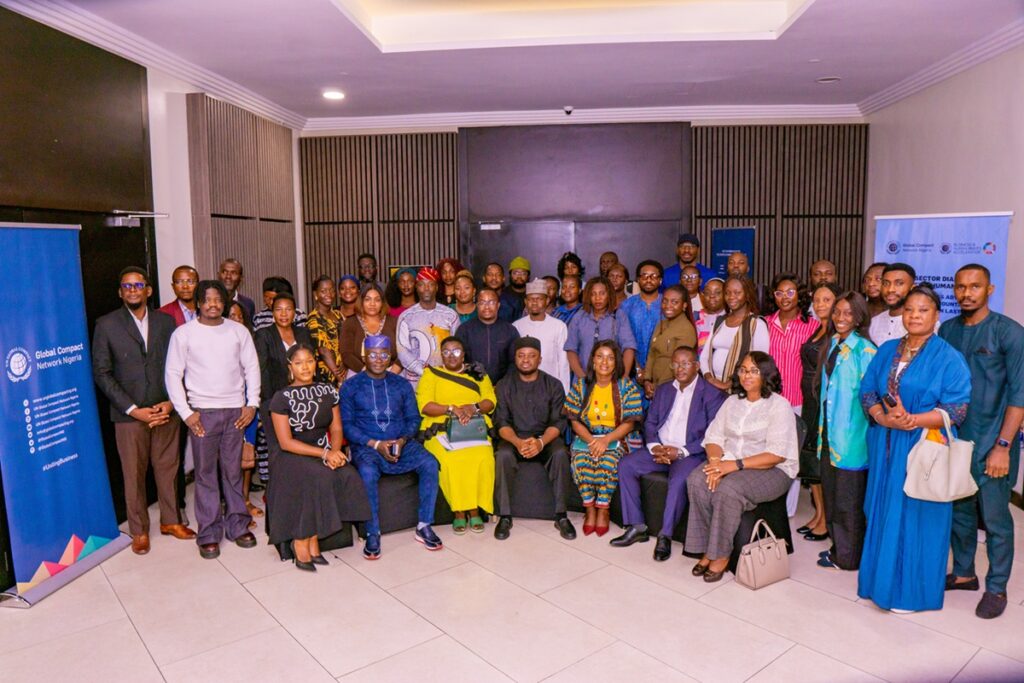
The event closed with a group photo and the distribution of souvenir packs — and the collective charge to make something happen before Monday.
The Private Sector Dialogue on Business and Human Rights was organised by the UN Global Compact Network Nigeria with support from Danish partners. The 2026 BHR Accelerator Programme is part of UNGCNN’s ongoing work to build a community of businesses committed to responsible conduct across Nigeria.
For more information on the BHR Accelerator and upcoming programmes, visit ungcnn.org or follow us on social media.